

Cloud runs
How screw-bugs Cloud tests a site or a pull request by itself, what a run may cost, and how to stop one.
A Cloud run is screw-bugs running on Cloud's side: Claude plans the cases, a cloud browser runs them, Claude reviews the result, and the report is published as a link. No local machine or coding agent is needed.
Not open yet
Only the screw-bugs team (Cloud's admins) can start Cloud runs for now. Everyone else is told "Cloud runs aren't open yet."
Starting a run
| From | What it tests | Where it answers |
|---|---|---|
A /screw-bugs PR comment | The PR's preview, planned from its diff | On the PR |
| A Slack mention (Slack: coming soon) | A site or a PR | In the thread |
Start a run (/runs/new) | A site by itself, at the address you give | On /runs only |
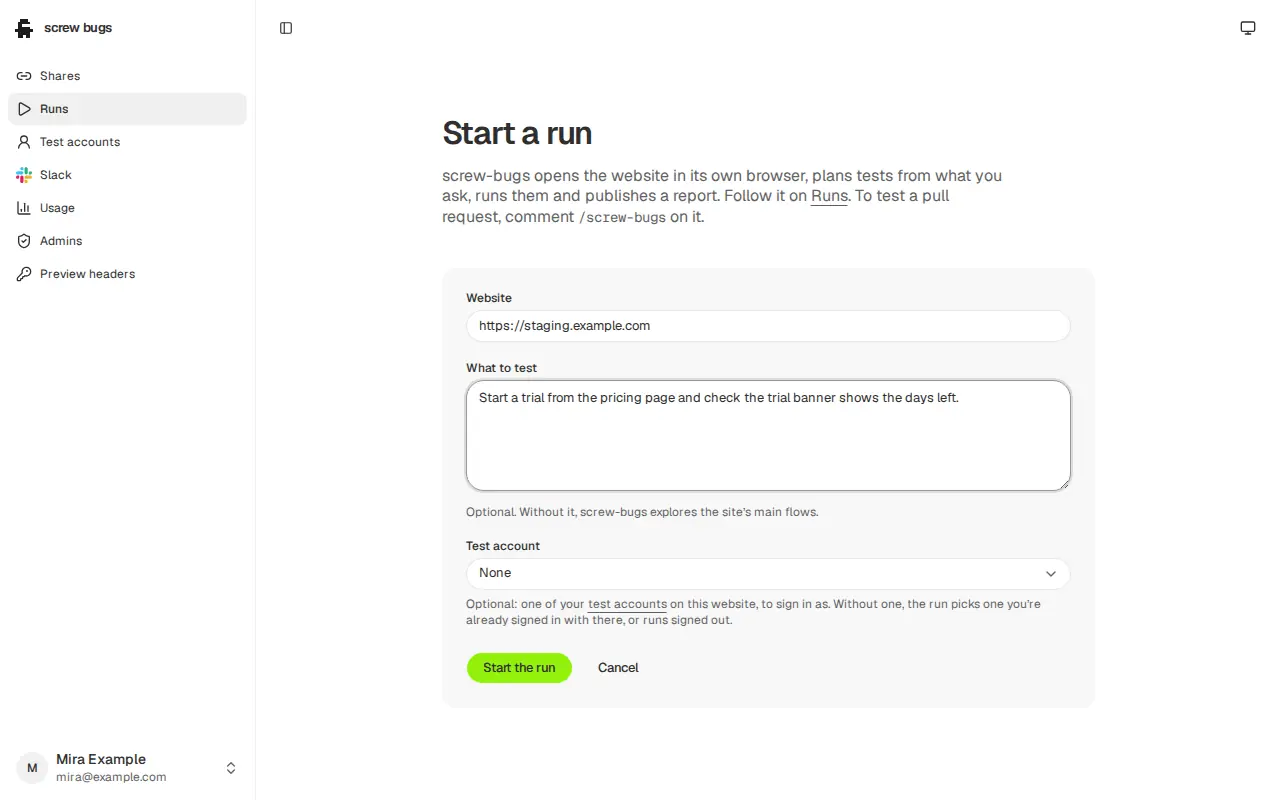
On Start a run, give the address, what to test in your own words, and optionally one of your test accounts. Runs (/runs) lists your runs and their reports.
What a run does
Plan
Claude looks at the site first, then writes the cases. A PR's run also reads the PR's diff.
Run
The screw-bugs engine (@screw-bugs/core) runs the cases on Cloudflare Browser Run. Each browser session is recorded to video.
Review
Claude reads the evidence and the screenshots of the cases that didn't pass, and tells the site's bugs from the cases' own mistakes. Its write-up shows in the report.
Publish
The report is published as a share on reports.screwbugs.dev (report sharing) and linked where the run was asked for.
Cost
Cloud runs aren't for sale yet. When they open:
| Plan | Price | Included each month |
|---|---|---|
| Cloud plan | $20/month | 1,000 browser minutes, 1.2M AI tokens |
| No plan | Free trial | Up to $2 of runs, in total |
Sharing reports stays free. Overage prices ($0.02 a minute, $10 per 1M tokens) are set but not billed yet.
Your cap. Your runs stop once they have cost $20 this month (plan), $2 in total (trial), or never (admins). A run's cost is what it costs us (the model's price per token, plus $0.09 per browser hour), not the overage prices above.
Each run also stops at the first of these (the defaults), and still gets a report of what ran:
| Per run | Cap |
|---|---|
| Tool calls | 150 |
| Tokens | 3 million, cached ones included |
| Wall time | 15 minutes |
| Cost | $2, or what's left of your cap (none for admins) |
- The run is the requester's (whoever commented, mentioned the bot or clicked Start): their cap pays.
- Once nothing is left, new runs are refused, and the bot says so.
- A run that ends gives back what it didn't use. The review is skipped once a cap is reached.
- Sign-in browsers for test accounts count too.
Stopping a run
The bot's first comment (or the Slack status message (Slack: coming soon), or the run's row on /runs) links to /runs/<slug>/stop.
- Open the link and sign in.
- Click Stop the run.
- The run ends at once, spends nothing more, and writes no report.
- Its PR comment or Slack thread (Slack: coming soon) says who stopped it.
- Who may stop it: for a PR, anyone who can push to the repository; for a site tested by itself, the person who asked. Admins can stop any run.
Protected previews: preview headers
Previews behind a login wall (Vercel Deployment Protection, Cloudflare Access) need a secret header. Admins set these per repository on Preview headers (/previews).
- Vercel:
x-vercel-protection-bypass(Protection Bypass for Automation). - Cloudflare Access: a service token's headers.
Runs send them only to the preview's own address (and to a site it redirects to). They are stored encrypted, never shown again, and never sent to a site a request names on its own.
How it works
- Every entry point calls one job API, which creates a job and starts a Cloudflare Workflow (
ReportJobWorkflow). - The Workflow runs the job step by step (choose an account, plan, run, review, finish) and resumes from the last finished step if a Worker dies.
- A failed step is tried again after 10 seconds, with exponential backoff: plan, run and review once more, quick steps twice. Each attempt's usage counts toward your cap.
- A run reserves its share of your cap when it is made, so runs started together can't overshoot it.
- Each step's model usage and browser time are recorded (
job_usage). - Browser Run has no ffmpeg, so the screencast streams to a separate encoder Worker, which makes a VP9 WebM, as local
screw-bugsdoes. - Preview headers and saved sessions are sealed with AES-GCM and opened only inside a run.
Code: apps/web/src/server/jobs (Cloud). Billing: docs/billing.md (Cloud).